
The Role of Scenario and Sensitivity Analysis for FP&A Professionals
Note: Revelwood sponsored this article. Revelwood provides solutions and resources for the office of finance. If you are interested in learning more about how Revelwood can help you or your business, you can check out their website here.
Executive Summary
One thing is certain in today’s world, and that is that the rate of change will continue to accelerate. The level of Volatility, Uncertainty, Complexity, and Ambiguity (VUCA) is higher than ever, and with that change comes a need for improved budgeting and forecasting processes. For most businesses, the days are gone when a single point estimate will suffice. The need for alternative plans and more robust risk analysis is more important than ever, which is where scenario and sensitivity analyses come in.
In this article, we are going to explore in greater detail the FP&A toolkit for managing risk, variability, and uncertainty, including:
Best practice tips for sensitivity analysis
Best practice tips for scenario analysis/management
Leveraging AI to enhance scenario and sensitivity analysis
The benefits of a modern tool stack
The demands placed on CFOs and FP&A departments have never been greater as the business looks to finance to help navigate these rapidly changing times. Managing these demands requires expanding our analytical toolkit, leveraging AI, and utilizing technology. If we continue doing what we have historically, we will fail to meet our business partners' needs. Throughout this article, a key goal will be to provide you with tips and frameworks you can start implementing in your business today to better manage planning and decision-making through scenario and sensitivity analysis.
The FP&A Toolkit for Managing Risk, Variability, and Uncertainty
“If you don't invest in Risk Management, it doesn't matter what business you are in; it's a risky business.”
- Gary Cohn, American Businessman
The best FP&A professionals understand that providing potential ranges, scenario plans, and a clear understanding of how movement in one variable can affect another are essential data points for guiding smart decision-making. There is a growing expectation that FP&A will be able to help answer the following types of questions when building models and influencing the decision-making process:
“What happens if…?”
“How sensitive are we to…?”
“What decision gives us the best downside protection?”
“How should we respond if there is a recession?”
“How big is the range of possible outcomes?”
Using techniques such as scenario planning, sensitivity analysis, and even Monte Carlo simulation is critical to answering these questions. This article focuses on scenario planning and sensitivity analysis. Before we define and go deep on sensitivity and scenario, I want to talk about Monte Carlo simulation briefly, as it will help round out your toolkit.
Monte Carlo Simulation
Monte Carlo simulation is a mathematical technique that runs a scenario multiple times to estimate the probability of different outcomes. A classic use case could be revenue forecasting, say you are building next year’s forecast, and instead of a single-point estimate, you identify the key uncertain drivers, such as contract value, customer acquisition, and churn rate. You establish a typical value and a range, then run various scenarios thousands of times. This will create a distribution of potential outcomes. For example, you might find that the expected revenue is $12M, but it has a 10% chance of falling below $8M and a 10% chance of exceeding $16M. This kind of information is invaluable because it helps establish ranges and is an ideal tool for supporting your scenario and sensitivity analyses. If you want to read more on Monte Carlo simulations, a great article on the topic by Christian Martinez can be found here. It is important to remember that Monte Carlo Simulations can augment your sensitivity and scenario analysis.
Sensitivity vs. Scenario Analysis
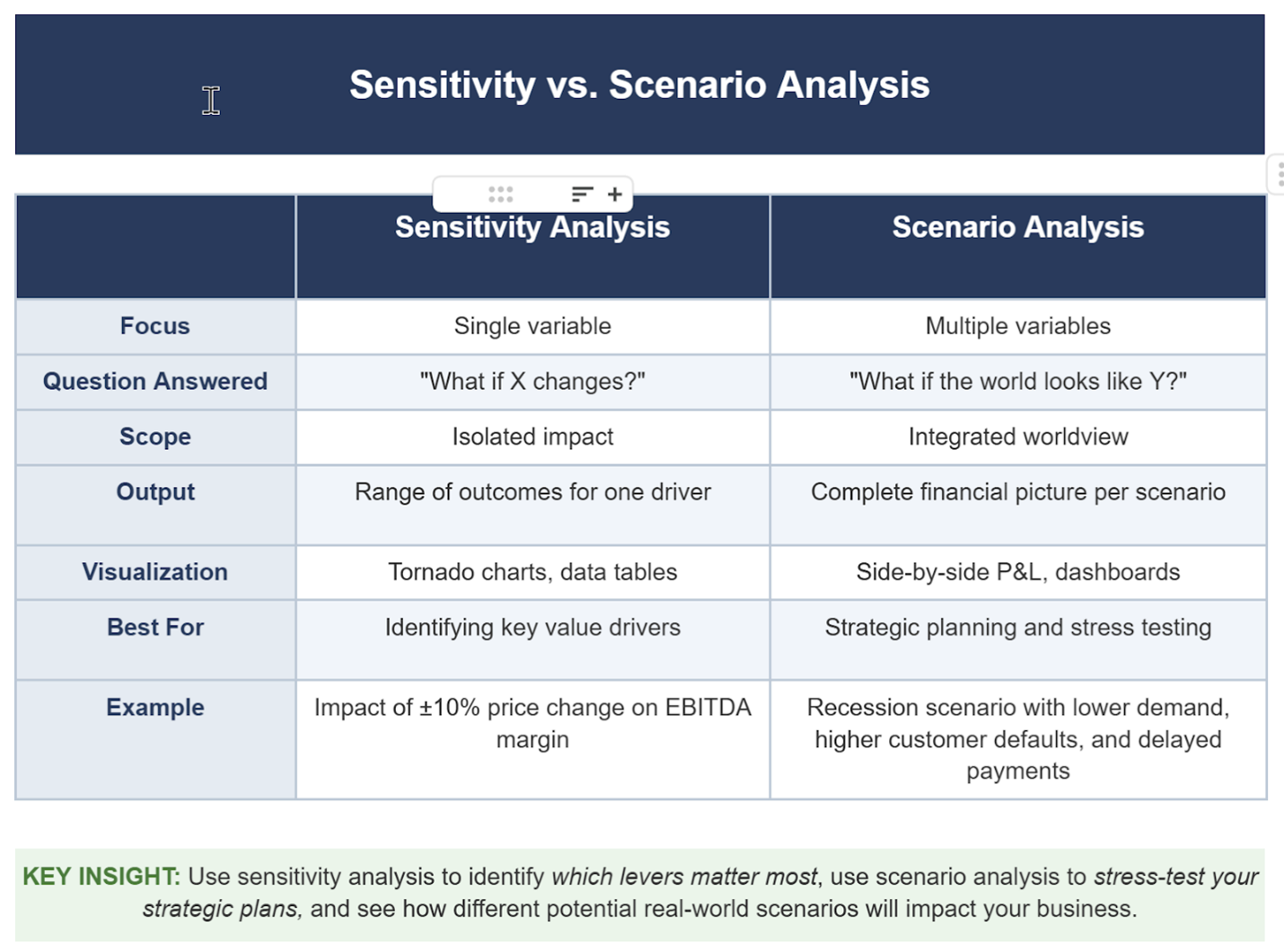
The Sensitivity vs. Scenario Analysis Table
Many people confuse scenario planning and sensitivity analysis, but they are two distinct activities that complement each other. The Sensitivity vs. Scenario Analysis table does a great job of comparing and contrasting sensitivity vs. scenario analysis. The way I like to think about it is that sensitivity analysis is all about determining how changes in one or more input variables affect an output. Let us take the following example: assume I own a company that sells protein smoothies. The most expensive ingredient in my protein smoothies is whey protein.
Therefore, I want to understand what happens to my Cost of Goods Sold when the cost of whey protein increases by 1%, and I would build a sensitivity analysis to calculate the impact. I could do this for all key variables and see how they impact different financial outcomes.
On the other hand, if I wanted to conduct a scenario analysis for my protein business, I would need to start by defining the scenario or situation I want to analyze. This could be an internal or external scenario, and a couple of examples of common scenarios could include what would happen to my business if:
I expanded into the Canadian market
I added a new line of protein bars
New government regulation impacted the ingredients I could use
A global recession occurred
As you can see, in scenario analysis, it starts with determining the situation to analyze, then deciding which key variables and inputs to consider for that situation.
Understanding the benefits of these different types of analysis and using them together enables better decision-making and a clearer understanding of the risks and opportunities inherent in our business and the other opportunities we face. In the following sections, we will go into more detail on best practices for implementing sensitivity and scenario analysis.
Best Practice for Scenario Analysis
“Scenario planning, far from being a sterile or academic exercise, is a way of making assumptions about the future in a rigorous and structured way. It is a disciplined method for imagining possible futures and working out what strategic responses would be robust across a range of futures.”
- Michael Porter, HBS Professor
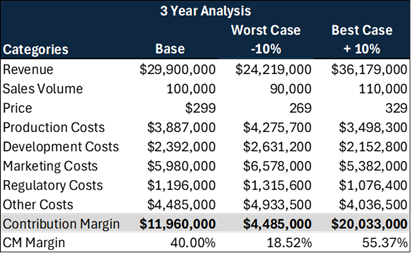
Sample 3 Year Scenario Analysis
In my experience, scenario analysis often unfolds like this. We need to create different scenarios for this project so management can see a range of possibilities. We then proceed to make worst-case and best-case analyses to go along with the base case, and it is often done by saying that in the worst case, the numbers drop 10-15%, and in the best case, they increase 10-15%. Here we can see a summary of what this often looks like.
In the example, we see a base case, along with worst- and best-case scenarios that assume the variables increase or decrease by 10%. While this might be useful, it misses the point and the key benefits of scenario planning. Scenario planning is about building realistic alternative scenarios.
For example, say you create an external scenario outlining the impact of changing banking regulations to require higher disclosures. This is an actual situation with specific effects you can model, and, as a business, you can build a plan to implement if this scenario occurs. Next, let us consider an internal scenario: say we have a base case of creating a manufacturing plant in a new market, and two alternatives: one is to form a JV with a manufacturer in the market, and the other is to buy an existing plant and retrofit it. In this situation, you can analyze each case and then develop a plan for the next steps for each scenario.
What each example has in common is that it is an actual business scenario that requires different choices and assumptions. This is very different from the best- and worst-case scenarios we so often see, which serve as little more than a range of possible outcomes, like a simple Monte Carlo simulation or a sensitivity analysis. The other key part of scenario analysis is planning, and this is often why I call it scenario planning: it requires building a plan to support the financial model, so when the time comes, you can implement the strategy behind the scenario. The planning phase is also where much of the collaboration with the broader business takes place.
FORECAST Framework
For scenario planning, One cau use FORECAST framework to help guide the process:
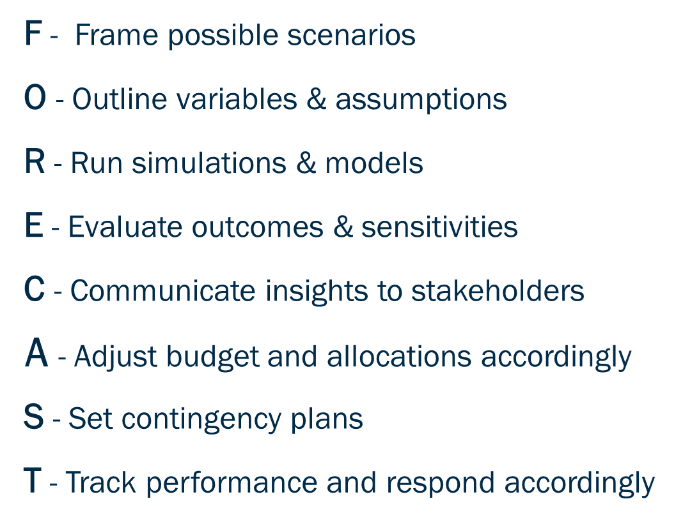
F - Frame possible scenarios. As you develop scenarios, determine how they align with strategic goals. You should also review industry trends, macro events, and what competitors are saying, as this will help with creating scenarios and assumptions. For each scenario you frame, select no more than 3-5 key drivers.
O - Outline variables & assumptions: outline the key variables and assumptions for each scenario. Write down what key variables are most important to each model and the logic behind your assumptions. Spend time validating your assumptions with key business leaders.
R - Run simulations and models - Once you have your scenarios clearly documented, build models that allow you to run simulations on the different scenarios. Use sensitivity analysis and Monte Carlo simulations to understand the range of possibilities and the key sensitivities within your scenarios.
E - Evaluate outcomes & sensitivities - Create a comparison of each key scenario, document the risks and opportunities for each, and review the assumptions and outcomes with all Subject Matter Experts, before making decisions. Make sure this is a collaborative exercise. When creating comparison data tables, the Spider and Tornado graphs can be used to compare the outcomes of different scenarios.
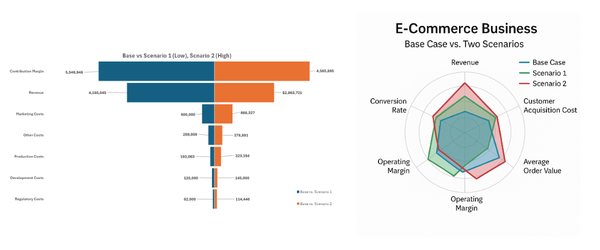
C - Communicate insights to stakeholders - As you communicate key insights to stakeholders, make sure to focus on the strategies and management decisions behind the scenarios and why the scenarios you have selected are the right ones to use. As you communicate these scenarios, include recommendations/calls to action to guide you moving forward. In some cases, you will move forward with a scenario; in others, you will hold it for implementation if specific changes occur, such as a recession or a change in government regulation.
A - Adjust budget and allocations accordingly - Make sure to adjust your budget based on the analysis of scenarios. Focus the main budget on the internal scenarios you plan to move forward with, and for external scenarios, prioritize the most plausible and create buffers for the areas of greatest risk. Make sure to document the rationale for any budget/forecast changes.
S - Set contingency plans - Set contingency plans to help guide when you will implement an external scenario or take action based on certain trigger events. If one of your scenarios is around a government regulation that could change or a recession, what is the trigger, and what is the action? Recommend creating a contingency matrix with the following information.
List of scenarios
What triggers action
Action to take if the trigger is reached
Owner of the action
How/what will you monitor
A sample contingency matrix is below:

T - Track performance and respond accordingly - The final step is to track your performance and ensure the business reacts appropriately. This includes monitoring alternative scenarios for trigger points and responding in accordance with your contingency plans when necessary. When implementing alternative scenarios, make sure you track the impact of each response.
Using the FORECAST framework takes you from conducting simple scenario analysis to implementing a method that utilizes scenario planning. Scenario planning helps you be better prepared for an uncertain future in which Volatility, Uncertainty, Complexity, and Ambiguity (VUCA) are expected.
Best Practice for Sensitivity (What-if) Analysis
While scenario planning is all about comparing different scenarios and deciding which to move forward with and which to monitor for later implementation, sensitivity analysis is all about understanding how a single input or variable affects an outcome, holding the other variables constant. A simple way to think about sensitivity analysis is that it is all about answering this question for leadership: “If this one thing changes, how much does it matter?”
Several common FP&A use cases for sensitivity analysis include:
How pricing changes affect revenue projections
How volume changes affect revenue projections
How changes in raw material costs impact gross margin
How FX movements impact profitability
How interest rate movements impact project costs
The above are just a few of the many different use cases for sensitivity analysis. With sensitivity analysis, it is easy to go overboard and try to test how every variable will impact the bottom line, but this is a fool’s errand, and to get the most out of sensitivity analysis, you need to implement some key best practices.
First, identify the 3-5 key drivers for your business. For example, if my business is airline travel, key drivers include fuel costs, aircraft capacity, and passenger demand. Once you have identified the key drivers, you can decide which ones to analyze for sensitivity.
Second, focus on meaningful ranges when testing key drivers. For example, if you are testing how your Margins change as your product's price changes, select reasonable intervals to test. If your product is currently priced around $90.00, you will not want to test how a 1-cent price change affects margin; instead, focus on a more reasonable range, such as how every $2.50 or $5.00 price change affects margin. When defining test intervals, consult your Subject Matter Experts (SMEs) to determine meaningful intervals.
Third, when conducting sensitivity analysis, ask yourself if there is a point at which behavior should change materially. For example, if you are looking at how Gross Margin changes based on volume, remember to consider constraints. For instance, my factory can only produce 100,000 units per month; after that, I will need new equipment or another factory, etc. These points at which the behavior of your input changes materially as it relates to your output are critical to keep in mind.
Fourth, ensure these exercises are not conducted in a vacuum and that the sensitivity analysis is tied back to business decisions. As FP&A professionals, it is essential that we conduct the analysis, share the results, and provide any recommendations. The business is looking for us to help guide decision-making, not just conduct analysis and then leave them to make all the decisions. After completing your analysis, have an opinion on the business impact and be willing to share it.
Using the above best practice tips will help you get the most out of your sensitivity analysis. In the next section, we will discuss ways to leverage AI to improve your sensitivity analysis and scenario planning.
Leveraging AI to Enhance Scenario and Sensitivity Analysis
“AI will make us more efficient and productive, freeing us up to focus on higher-level tasks.”
– Fei-Fei Li, Godmother of AI
Many opportunities exist for using Generative AI and Machine Learning to enhance sensitivity and scenario planning. Several use cases for AI include:
Analyzing historical data sets to find and surface non-obvious relationships and patterns in the data
Using Machine Learning algorithms to improve forecasting of key drivers in your scenario planning
Assisting in building and running Monte Carlo simulations
Using Generative AI to help with different potential scenarios for your business
Using Generative AI to assist in developing the key drivers and assumptions that should be used in your scenario models
Share assumptions with AI and ask AI to challenge your assumptions and provide suggestions to improve your assumptions
AI can help with building sensitivity analysis and thinking about what key variables you may want to run what-if analysis on
The key is to use AI as an assistant throughout the process. You will still need to validate the work performed by AI, but using AI will allow you to improve the quality of your work while accomplishing more in less time. If you're not sure where to start with AI, start by using generative AI to bounce ideas off for the different scenarios you develop and the core assumptions that play a role in each scenario you generate. Over time, as you experiment with AI, you will find yourself using it more.
The Necessity of a Modern Tool Stack
“Technology empowers innovation and efficiency. Leverage it to elevate your work and your impact.”
– Allison Dunn, Business Coach
Most companies today manage planning with Microsoft Excel, and while this can work as companies scale and become more complex, it becomes more challenging and time-consuming to manage. Take scenario planning, for example, building multiple real-world scenarios in Excel is challenging and requires excellent, disciplined modelers to manage it. Even with well-designed models, limitations exist. Take the situation that is all too common: you build your model, and then management comes back and asks to see the data in a different format or with new dimensions (e.g., by product or geography). This seemingly simple request often takes substantial time and effort to answer.
This is where modern planning tools are incredibly valuable, as they make it easy to run multiple scenarios, perform Monte Carlo simulations, and conduct real-time what-if analysis. Imagine being able to efficiently conduct sensitivity analysis on all key variables in your meetings with management and see how they influence the financials, or create a new scenario on the fly and easily flow it through your financials.
This is one area where a modern planning tool shines, allowing you and your finance department to focus on analysis rather than model building. This is just one of the many benefits of modern planning software. These tools also make it much easier to integrate your data, create your monthly reports, and collaborate with your business partners. As you work to manage your business's needs better, consider implementing purpose-built planning software to simplify scenario planning and sensitivity analysis.
If you are reading this and thinking that my tech stack stinks or that I need to incorporate a modern planning tech stack, I recommend reaching out to an expert for advice. One firm that has decades of experience in this space that could assist you with your FP&A transformation is Revelwood. You can learn more about Revelwood here. Talking to an expert is always a great way to jump-start your transformation journey.
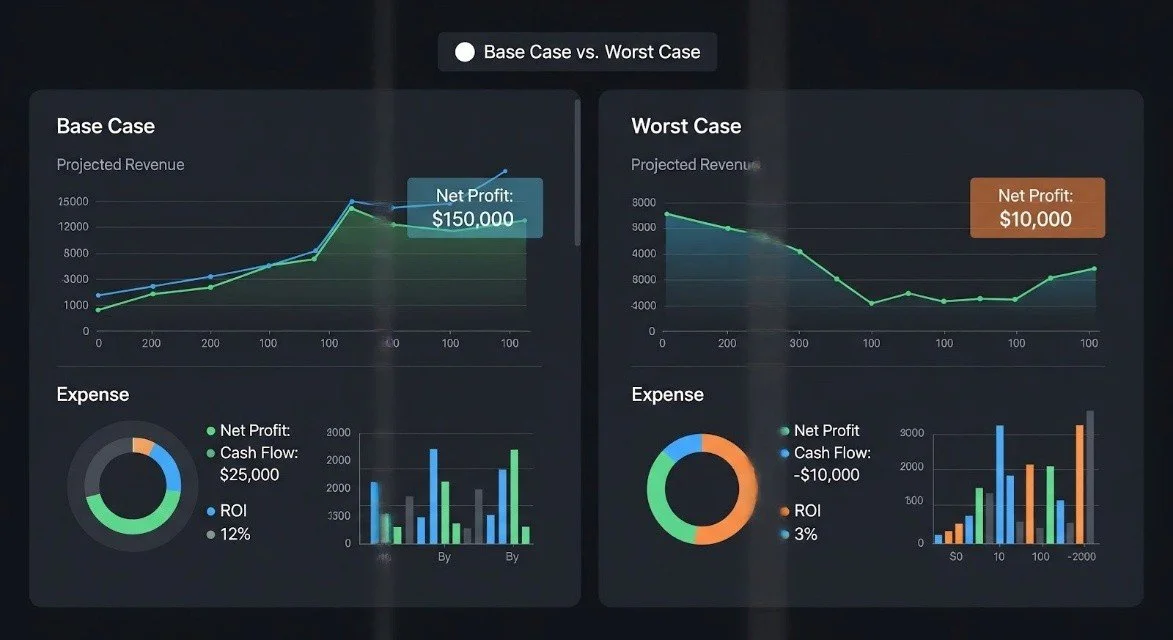
The pace of change will continue to accelerate, and the demands placed on finance departments to help business leaders make better, faster decisions will only grow. This will require FP&A departments to be more agile and analytically focused, and sensitivity analysis and scenario planning are key skills that FP&A professionals should incorporate. These techniques are part of the modern analytical foundation needed to navigate uncertainty, identify critical risk factors, and make confident decisions that drive organizational success.
Moving forward, finance departments will need to leverage these analytical methods, along with artificial intelligence (AI) and a modern tech stack, to achieve more. With AI and a modern tech stack, FP&A departments will be able to model risk and conduct sensitivity analysis in less time, with greater accuracy than ever before.
However, technology and analytical tools alone are not enough to successfully implement these methods; you will also need to adopt best practices and work closely with the business. Scenario planning and sensitivity analysis are not just exercises for finance to perform in a vacuum; they require participation from the entire company. When everyone is on the same page, these tools will prepare your business to make adjustments more quickly and take advantage of the ever-changing 21st-century business landscape.